
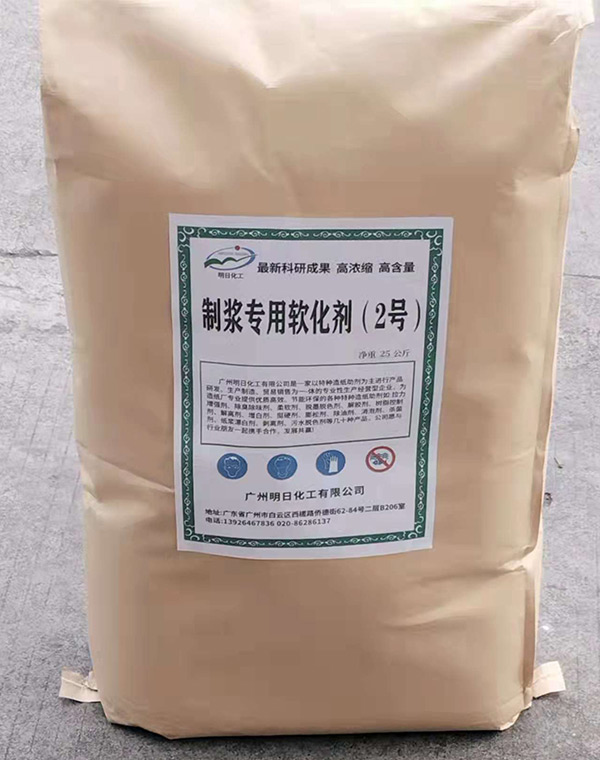
User Manual for Bamboo and Wood Fiber Softener
1、 Product Introduction:
China has abundant resources of papermaking fibers. The key to utilizing these abundant resources to produce high-quality paper products lies in the issue of "environmental protection". Previous pollution control methods could only treat the symptoms rather than the root cause. To completely solve the pollution problem, it is necessary to fundamentally solve it - the pulping process does not produce black liquor. If no black liquor is produced or only a small amount of black liquor is produced, the pollution control problem will be easily solved.
At present, after years of unremitting efforts, our company has developed a specialized "bamboo and wood fiber softener", commonly known as "fiber softener", in the field of pollution-free pulping technology. The characteristic of this product is to use "biological methods to pulping" fiber materials such as bamboo, wood, wheat straw, rice straw, cotton stalks, and reeds, replacing "chemical pulping"; Using "cold soaking method" and "spray method" instead of "cooking method", bamboo, wood, straw, cotton stalks and other fibrous materials are soaked in a softener and then subjected to biocatalysis to soften wood fibers and non fibrous substances such as lignin and pectin, in order to produce pulp.
2、 Function Introduction
This product is mainly used as a cold soak, pipeline heating, or circulating spray additive added to bamboo, cotton, and other papermaking pulp. It is a softening agent formulated based on the principle of biodegradation of non fibrous substances. It can degrade and saccharify non grass fibers, lignin, pectin, etc. at room temperature to achieve the purpose of fiber softening.
3、 Physical and chemical properties
This product is a composite agent. Under normal usage, it is: 1. Fiber Softener 1 (liquid), 2. Fiber Softener 2 (solid; also known as Catalyst 2); 3. Fiber softener No. 3 (solid; also known as catalyst No. 3) is used in equal proportions. The effective substance content is 98%.
4、 Usage:
1. Spray humidification method; 2. Method of soaking the medicine at room temperature; 3. Heating method for pipelines; 4. Steam cooking methods, etc;
5、 Proportion and dosage:
1. Using spray humidification method, the ratio and dilution ratio with water are as follows:
Spray humidification formula: Use fresh bamboo slices with a moisture content of about 40-50% and add 800-900 kilograms of water to 1 ton of bamboo slices; (Dry bamboo slices with a moisture content of about 20% and 1000 kilograms of water)+6 kilograms of softener 1+10 kilograms of softener 2+1 kilogram of softener 3+50 kilograms of tablet alkali;
Operation method: Mix softening agents 1, 2, and 3 directly with a specified amount of caustic soda or alkaline solution in clean water, dissolve and stir. After complete dissolution, spray the solution onto the crushed fibers at the outlet of the crusher and mix and stir the agents; Cover with plastic cloth for insulation, heating, fermentation and maturation. Fermentation time: 2-2.5 days in summer for production; It can be fully matured in 3 days in winter;
Using room temperature chemical soaking method: its ratio and dilution ratio with water: using fresh bamboo slices with a water content of about 40-50%, add 1300 kilograms of water to 1 ton of bamboo slices; (Dry bamboo slices with a water content of about 20% plus 1500 kilograms of water)+6 kilograms of softener 1+10 kilograms of softener 2+1 kilogram of softener 3+50 kilograms of tablet alkali;
Operation method: Mix softening agents 1, 2, and 3 directly with a specified amount of caustic soda or alkaline solution in clean water, dissolve and stir. After complete dissolution, soak the bamboo slices in water and heat them for fermentation and maturation. Fermentation time: 2-2.5 days in summer to produce; It can be fully matured in 3 days in winter;
;
ƒ Pipe heating: Use fresh bamboo slices with a water content of about 40-50% and add 800 grams of water to 1 ton of bamboo slices; (Dry bamboo slices containing 20% water and 1000 kilograms of water)+6 kilograms of softener 1+10 kilograms of softener 2+1 kilogram of softener 3+50 kilograms of tablet alkali;
Operation method: Directly mix softener 1, 2, and 3 with a specified amount of alkali or alkaline solution in clean water, dissolve and stir. After complete dissolution, add the liquid medicine to the pipeline through spraying at the inlet of the pipeline together with bamboo slices for mixing and stirring; Simultaneously add steam heating channels to maintain a temperature of 90-120 degrees Celsius for fermentation and maturation, with a fermentation time of 2.5-3 hours in summer; It can fully mature within 4-5 hours in winter;
5、 Bamboo, cotton stalks, and fast-growing poplar pulping process
Process description of fiber softening and dissociating agent:
(1) Pre treatment - mainly using recycled waste soaking solution to pre soak cotton stalks, making coarse grinding and separation more thorough.
(2) Stacking, soaking, and biodegradation - This process is the main process of pulp making. It involves stacking crushed pulp materials on a cement hardened ground, soaking them while stacking, and maintaining the soaking state until the hydrolysis is completed.
(3) Softening and tempering - The slurry that has been biodegraded by biological catalysis does not meet the physical indicators for slurry formation after precision grinding treatment, and should be subjected to tempering treatment to fully meet the requirements for slurry formation.
(4) Processing of pulp - For the reprocessing of pulp, users can set it according to their own conditions and copying requirements.
(5) Reuse of treated water - soaking water can be recycled, and if discharge needs to be treated, ordinary sewage treatment agents such as polyaluminum chloride, polyacrylamide, etc. can be used for sewage separation; Because the non fibrous substances dissolved from the soaking solution are discharged through precipitation. The upper clear water has returned to the pulp making system, so users do not have to worry about causing secondary pollution, ensuring a closed cycle of soaking water. The entire pulp making process has no pollution emissions, low investment, and quick results. Generally, paper and pulp enterprises can resume production with slight modifications, which is suitable for large, medium, and small paper enterprises to produce board paper and packaging paper.
6、 The role and effect of this product in the pulp making process
Our company's new pulping technology adopts "biological pulping" instead of "chemical pulping" and "cold soaking method" instead of traditional "steaming and boiling method"; The benefits of this method include:
1. The pH value of the slurry decreases; The pH value of the slurry made from softener is only 8.5-9; The pH value of the slurry made with caustic soda should be 12, 13, or above;
2. Bonding degree (fiber length): The bonding degree of pulp made with softener can reach 23, with longer fiber length and stronger pulp strength; However, when using caustic soda to make pulp, the degree of jointing is generally only around 10 degrees, and the fiber length is short;
3. Ash content: The ash content of the slurry made with softener is only around 5; The ash content of the slurry made with caustic soda is above 9-10;
4. In terms of COD, the slurry made with softener has a COD value of only around 6000-7000; The COD value of the slurry made from soda ash is above 10000-20000;
5. And the increase in output: the average output of pulp made with softeners: 1 ton of bamboo slices can produce more than 50-60 kilograms of finished pulp;
6. The pulp made does not require washing; And save more than 25% of the cost of using chemicals; Especially the cost saving effect of pipeline heating is particularly significant;
7. Increase fermentation and maturation time by nearly one-third; Improve production capacity;
8. Because the non fibrous substances dissolved from the soaking solution are discharged through precipitation. The upper clear water has returned to the pulp making system, so users do not have to worry about causing secondary pollution, ensuring a closed cycle of soaking water. The entire pulp making process has no pollution emissions, low investment, and quick results. Generally, paper and pulp enterprises can resume production with slight modifications, which is suitable for large, medium, and small paper enterprises to produce board paper and packaging paper.
7、 Reminder for trial samples:
1. Please pay attention to the trial sample of fiber softener! Due to the limited amount of bamboo and wood pulp used in small-scale production, there are no environmental conditions that can generate heat, fermentation, and maturation reactions. Therefore, fiber softener small-scale tests often do not achieve completely satisfactory maturation results!
2. Two comparative sample tests can be conducted simultaneously: one is a sample made by adding alkali to the softener according to the ratio of the softener; 2 is a test sample based on the actual amount of caustic soda used previously; Comparison of the effects of the two under the same temperature conditions;
3. If you want to achieve satisfactory trial results, it is recommended to try bamboo slices in quantities of at least 1 ton in order to produce a heating, fermentation, and maturation process and achieve completely satisfactory results;
8、 Storage: This product has a shelf life of 18 months; Store in a well ventilated and dry place;