
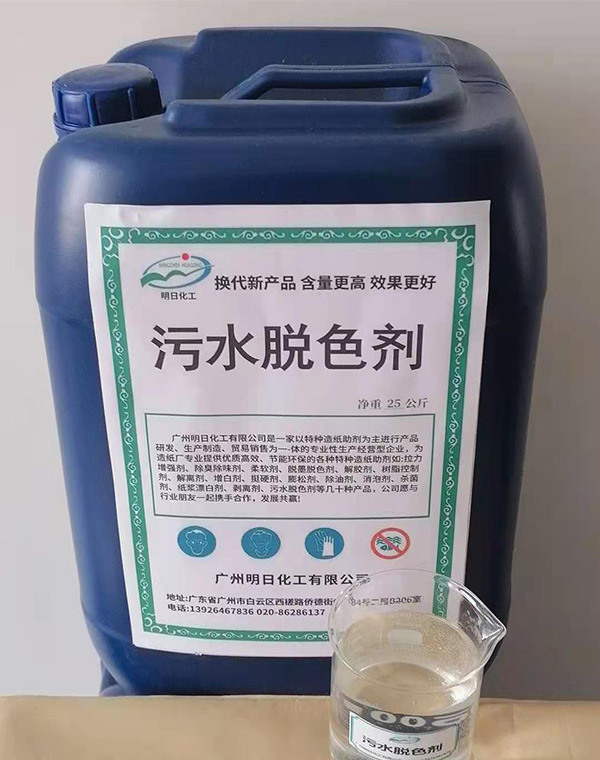
Product manual for new sewage decolorizer
The new and efficient "sewage decolorizer" is a new technology product independently developed by our company, mainly used for decolorization treatment of black, red, yellow, blue and other sewage colors in paper mills, printing and dyeing factories, etc; By using sewage decolorizing agents for decolorization treatment, the water can achieve a clear and transparent effect, restoring the original color of the water and ensuring no color pollution; Obtain the requirements for discharge water quality;
1、 Product specifications:
1. Main components: high molecular weight decolorizing polymer;
2. Appearance: White transparent liquid;
3. PH value: 6-7;
4. Ecological characteristics: non-toxic and pollution-free; Has no effect on biochemical bacterial strains
2、 Sample method:
1. Take an appropriate amount of wastewater (about 500ml) with a beaker and adjust the pH value between 7-9;
2. Dilute the sewage decolorizer to a decolorizing agent solution at a ratio of 1:20; Dilute polyaluminum chloride at a ratio of 1:50;
3. Add decolorizing agent solution to the wastewater, stir for half a minute, then add polyaluminum chloride solution, stir again for half a minute, and let it stand;
4. Observe whether the color of the wastewater supernatant meets the requirements. If not, adjust the dosage and repeat the third step;
5. Calculate the dosage of decolorizing agent and other coagulants per ton of wastewater based on experimental data until the desired effect is achieved;
Note: Our company recommends using 0.001% -0.004% of the wastewater decolorizing agent (10-40 grams per ton of wastewater) and 0.002% -0.006% of polyaluminum chloride (20-60 grams per ton of wastewater), depending on the color of the wastewater and the treatment process.
Precautions for decolorizing agent test
·The dilution ratio of the decolorizing agent is generally above 20 times, which is conducive to the unfolding of the decolorizing agent molecular chain and its performance, and can effectively control the dosage;
·The combination of decolorizing agent and polyaluminum can achieve the best effect, as the flocs and compactness formed by decolorizing agent are relatively small. The combination with polyaluminum can not only increase the compactness and settling of flocs, but also reduce the amount of decolorizing agent through synergistic effect;
·Each addition should be stirred quickly for 1 minute and then slowly for 30 seconds, which is beneficial for enhancing the flocculation effect of the additive;
·The order of addition should not be reversed. The decolorizing agent should be added first, followed by polyaluminum, and finally polypropylene XI amide. Experimental data shows that the dosage of decolorizing agent can differ by about 20% after reversing the order of addition;
·If there is a whitening phenomenon in the supernatant of the wastewater or the COD of the supernatant is higher than before dropwise addition, it indicates that the decolorizing agent is added in excess and needs to be reduced;
During the experiment, use a beaker to measure the wastewater, with a water volume of at least 200ml, which can reduce the error in the amount of additives used during the large-scale experiment;
·If the wastewater appears acidic or strongly alkaline, the pH value should be adjusted to slightly alkaline, usually around 8, because decolorizing agents and polyaluminum are acidic aqueous solutions that are conducive to electrical neutralization. Some wastewater can also precipitate flocs after adjusting the pH value to alkaline, which can reduce the amount of chemicals used.
3、 Normal usage and operation method:
1. Wastewater decolorizer: Use plastic drums or other plastic containers weighing 200-1000 kilograms or more, install plastic valves, and dilute the agent with water at a ratio of 1:20 for later use;
2. Polyaluminum chloride: Use plastic drums or other plastic containers weighing 200-1000 kilograms or more, dilute with water at a ratio of 1:20 for later use;
3. Alkali: Use plastic drums or other plastic containers weighing 200-1000 kilograms or more, dilute with water at a ratio of 1:20 for later use;
4. Dosage: Add 10-40 grams of sewage decolorizer to 1 ton of sewage for continuous online addition;
5. Add the internal circulating water and sewage discharge outlet of the workshop (from the production workshop sewage discharge ditch to the middle of the sewage treatment tank);
The inlet of the factory sewage treatment tank should be added before adding the sewage treatment agent; (Add in front of the addition point of polyaluminum chloride;
If there is a biochemical process, please add it to the outlet of the biochemical tank and in front of the secondary sedimentation tank; If there is no biochemical process, directly add it to the dosing tank and adjust the dosage of the agent according to the effluent color of the sedimentation tank until it meets the discharge or reuse standards.
4、 Operation sequence:
Step 1: Please test the pH value first; This product is used under alkaline environmental conditions. If the pH value is less than 7-8, please add alkaline solution dropwise to adjust the pH value to around 8, which is slightly alkaline;
Step two; Continuous addition of "sewage decolorizer" using a drip method: Open the decolorizer valve, increase the amount from small to large, and observe the color in the water changing from dark to light until the color completely disappears as the accurate amount; Mix the sewage decolorizer solution with the propeller through the flow of sewage, so that the color in the sewage can be removed through chemical reaction, making the water quality clearer;
Step 3: Properly use polyaluminum chloride and other materials to further purify water quality, making the water treated with sewage decolorizing agents clearer and more transparent, with better color removal rate;
Packaging and Storage:
1. 25kg plastic drum packaging;
2. Store in a well ventilated, cool, and dry place with sealed packaging. Pay attention to ventilation and dryness, and handle with care during loading and unloading; Please do not expose to direct sunlight in the following days;
3. Storage time; 12 months;