
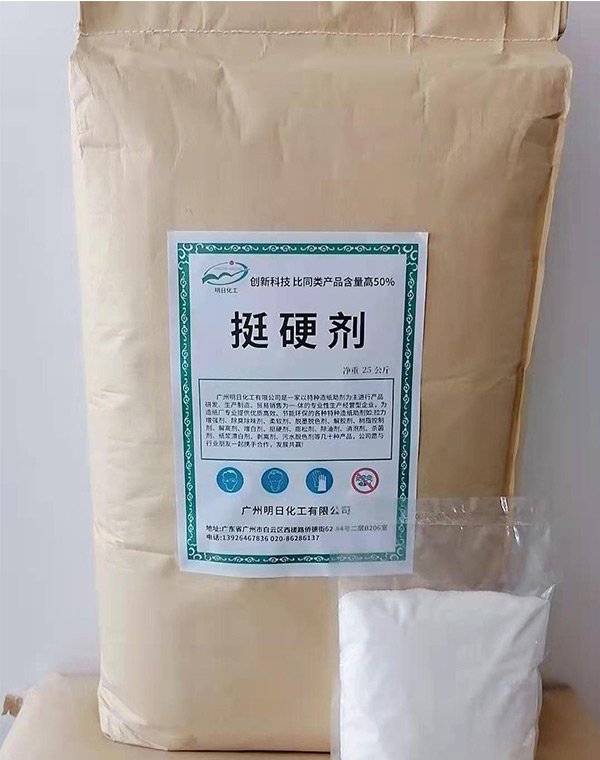
Guangzhou MingRi Chemical Co., LTD
Water repellent Material Safety Data Sheet
Part One: Chemicals and Enterprise Logos
Chemical Chinese name: Stiffening agent
Chemical English name: Stiffening agent
Company name: guangzhou tomorrow chemical co., LTD
Part Two: Component/Composition Information, Main Indicators and Uses
Component content (%)
Polyacrylamide 7%
DAC 6%
Initiator 3%
CMC 2%
PVA 2%
80% water
Main indicators:
Appearance: Colorless semi-transparent liquid
Effective content: 20%±1
PH value (25℃) : 3-6
Viscosity (25℃) : 3000-8000 mPa.s
Ionic: Amphoteric
Room temperature validity period: 6-8 months
Main uses: To enhance the bursting resistance, folding endurance and strength of paper.
Part Three: Overview of Hazards
Health hazard effect: It basically does not irritate the skin and has a very slight ability to damage the eyes
Environmental impact: None
Physical and chemical hazards: Non-flammable and non-explosive.
Routes of invasion: Inhalation, ingestion
Classification of hazards of items: Non-hazardous items
Part Four First Aid Measures
Skin contact: Remove contaminated clothing and thoroughly wash the skin with soapy water and clean water.
Eye contact: Lift the eyelids and rinse with plenty of water. Seek medical attention if necessary.
Inhalation: Quickly evacuate the scene to a place with fresh air and keep the airway clear. If breathing stops, perform artificial respiration. If breathing is difficult, receive supportive therapies such as oxygen infusion and seek medical attention.
Ingestion: Drink plenty of warm water as much as possible, try to induce vomiting, and seek medical attention if necessary.
Part Five Fire Protection Measures
Hazardous characteristics: Non-flammable and non-explosive
Fire extinguishing methods and agents: Applicable to chemical dry powder, carbon dioxide, and polymer foam fire extinguishing
Fire extinguishing precautions: No special matters
Part VI Leakage Handling Methods
Environmental precautions: Avoid water and open flames
Treatment method: Dilute with a large amount of water and bury with construction waste
Part Seven: Safe Disposal and Storage Methods
Disposal: This substance is basically non-toxic. Wearing appropriate personal protective equipment is sufficient
Storage: Keep away from moisture, fire and maintain the ambient temperature below 35℃
Part 8 Contact Control/Personal Protection
Protective measures: Eye/Facial protection: Use safety glasses. If exposed, it may cause eye discomfort and chemical goggles should be worn
Skin protection: No preventive measures are required. Gloves can be used when necessary
Respiratory protection: When dust or smoke appears, please use an air-purifying respirator
Part Nine Physical and Chemical Properties
Appearance: Colorless semi-transparent liquid
Effective content: 20%±1
PH value: 3-6
Viscosity (mpa.s at 25℃) :3000-8000
Ionic: Amphoteric
Part X Safety and Reactivity
Safety: Stable under normal conditions
Reaction under special circumstances:
After the open flame combustion test, no flammable or explosive phenomena were produced
2. It has no violent reaction with reduction and poses no risk of oxidation
3. The contact test with objects shows no obvious damage and the product poses no risk of corrosion
Part Eleven Toxicity Data
Inspection items, inspection results, conclusion
Acute oral toxicity in mice > 10 is actually non-toxic
Acute skin irritation in rabbits 0: No irritation
The mutagenic AMES test was negative
Part Twelve Ecological Data
Possible environmental impacts:
It is difficult to be absorbed by the stomachs and intestines of humans and animals
2. It leaks into the soil and can be naturally degraded
Part Thirteen: Waste Disposal Methods
Refer to the relevant regulations for handling
2. Store the waste to be processed in accordance with the storage conditions
3. Handle by specific incineration or safe and hygienic landfill methods
Part Fourteen: Transporting Materials
International transportation regulations: It is not a dangerous good according to the International Maritime Transport of Dangerous Goods Code
United Nations Number: None
Domestic transportation regulations: Transportation shall be handled in accordance with the conditions of ordinary chemical products
Precautions: Fire prevention, moisture prevention, and the ambient temperature should be kept below 35℃
Part XV Regulatory Information
Stiffening agent, non-hazardous, does not need to be classified as a dangerous good under EC-D
Part Sixteen Other Information
Produced by: Guangzhou Mingri Chemical Co., LTD
Date: June 18, 2016